

Mineral vs Chemical Sunscreen – Which Is Better for Pakistan?
Confused between mineral and chemical sunscreen? You are not alone. In Pakistan's heat, humidity, dry weather and strong sunlight, the best sunscreen type depends on your skin type, texture preference and daily routine.
Mineral sunscreen is often preferred for sensitive skin, while lightweight gel-style sunscreens usually feel better for oily skin and humid weather. The right choice is the sunscreen you can apply properly and use every day.
Quick Answer: Mineral vs Chemical Sunscreen
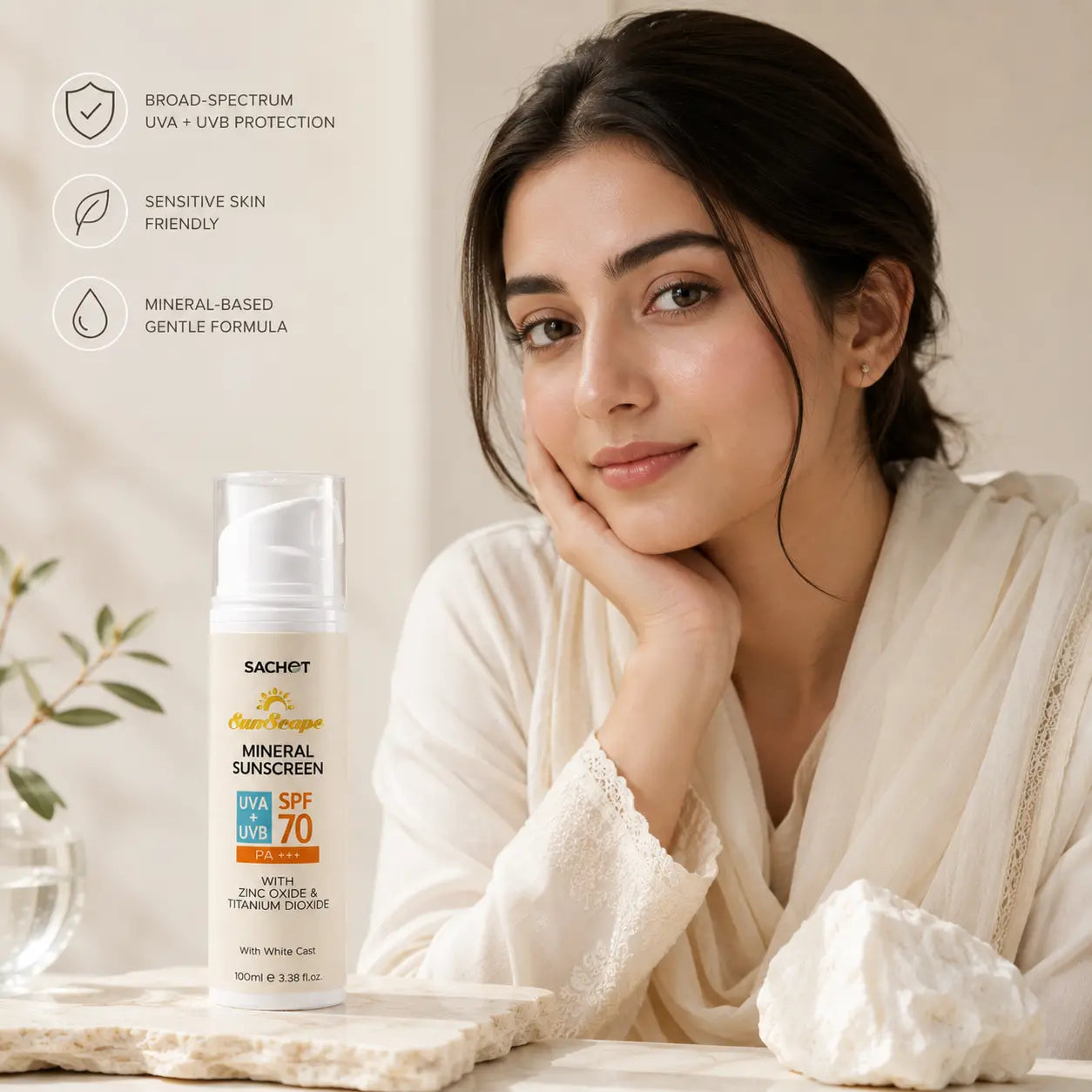
Mineral-first sunscreen is usually better for sensitive, reactive or redness-prone skin because it leads with physical UV filters such as Zinc Oxide and Titanium Dioxide. Lightweight gel sunscreen often feels better for oily skin because it absorbs faster and usually feels less heavy in Pakistan's humid weather. Most modern mineral sunscreens are hybrid formulas — mineral-first but with small stabilizing ingredients for better wearability.
- Choose mineral-first sunscreen: sensitive, reactive, redness-prone or post-facial skin.
- Choose gel sunscreen: oily, sweaty, acne-prone or humid-weather skin.
- Choose tinted sunscreen: no white cast, uneven tone or makeup routine.
- Choose moisturizing sunscreen: dry, tight or flaky skin.
Mineral vs Chemical Sunscreen: Quick Comparison
| Feature | Mineral-First Sunscreen | Chemical / Gel Sunscreen |
|---|---|---|
| How it works | Leads with mineral UV filters such as Zinc Oxide and Titanium Dioxide. May include small stabilizing ingredients for better texture. | Uses lightweight UV filters that absorb into the formula and feel lighter on skin. |
| Best for | Sensitive, reactive, redness-prone and post-treatment skin. | Oily, acne-prone, sweaty and humid-weather skin. |
| Texture | Can feel more protective. Apply in thin layers and blend well. | Usually lighter, fresher and easier to wear daily. |
| White cast risk | Can leave slight white cast if applied too thickly. Blend well for best results. | Usually lower white cast risk, especially in gel textures. |
| Makeup compatibility | Works best in thin layers. | Often easier under makeup because of lighter texture. |
| Pakistan weather fit | Best for sensitive skin and strong sun exposure. | Best for humidity, oily skin and daily lightweight comfort. |
What Is Mineral Sunscreen?
Mineral sunscreen uses UV filters such as Titanium Dioxide and Zinc Oxide as its primary protection. These mineral filters sit on the skin and help block UV rays physically, which is why mineral sunscreens are often preferred for sensitive or reactive skin.
- Good for sensitive or reactive skin.
- Useful after facials or active skincare routines.
- Often preferred for redness-prone skin.
- Good for people who want mineral-led sunscreen filters.
- Apply in thin layers and blend well for best results.
What Is a Hybrid Mineral Sunscreen?
Most modern mineral sunscreens on the market — including premium formulas — are hybrid formulas. This means they lead with mineral UV filters such as Zinc Oxide and Titanium Dioxide for primary protection, but also include small quantities of stabilizing ingredients such as Avobenzone or Benzophenone to improve formula stability, blending and wearability.
A 100% pure mineral sunscreen using only Zinc Oxide with no other ingredients would be very thick, hard to blend and extremely uncomfortable in Pakistan's heat. Stabilizing ingredients are added in small quantities to make the formula more practical for daily use without changing the mineral-first nature of the protection.
Skincare expert note: Avobenzone and Benzophenone-3 in mineral-first sunscreens are typically used as stabilizers in low quantities. Their primary role is to support formula stability and improve texture — the main UV protection still comes from the mineral filters Zinc Oxide and Titanium Dioxide.
This is standard formulation practice and is used by many well-regarded sunscreen brands globally. A mineral-first hybrid sunscreen gives you the sensitive-skin comfort of mineral UV filters in a more wearable, blendable formula.
SACHET Mineral Sunscreen SPF 70 — Mineral-First Hybrid Formula
Leads with Zinc Oxide and Titanium Dioxide for mineral UV protection. Ceramides support the skin barrier. Small stabilizing ingredients improve texture and blending. Best for sensitive, reactive and redness-prone skin. Apply in thin layers and blend well.
Shop Mineral SPF 70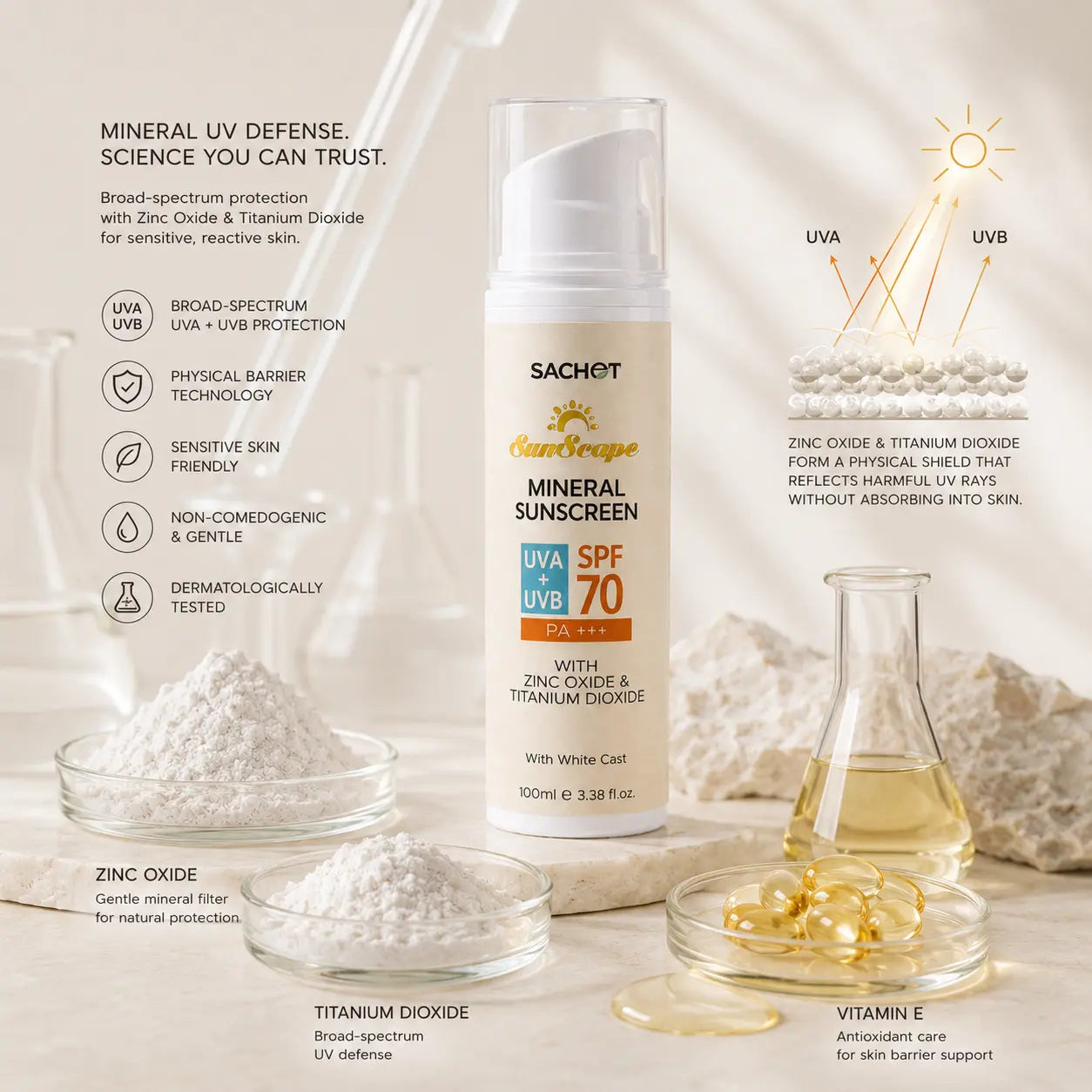
What Is Chemical or Gel Sunscreen?
Chemical or lightweight gel sunscreens are often preferred by oily and combination skin users because they usually feel lighter, absorb faster and sit more comfortably in humidity.
- Lightweight transparent gel feel.
- No white cast.
- Better for oily, sweaty or acne-prone skin.
- Usually easier under makeup.
- Good for humid cities like Karachi and Lahore.
Best Lightweight Pick: Aloe Vera Gel Sunscreen SPF 50
Choose Aloe Vera Gel Sunscreen SPF 50 if your skin is oily, acne-prone or uncomfortable with heavy sunscreen textures. Lightweight transparent gel — no white cast.
Shop Aloe Vera Gel SPF 50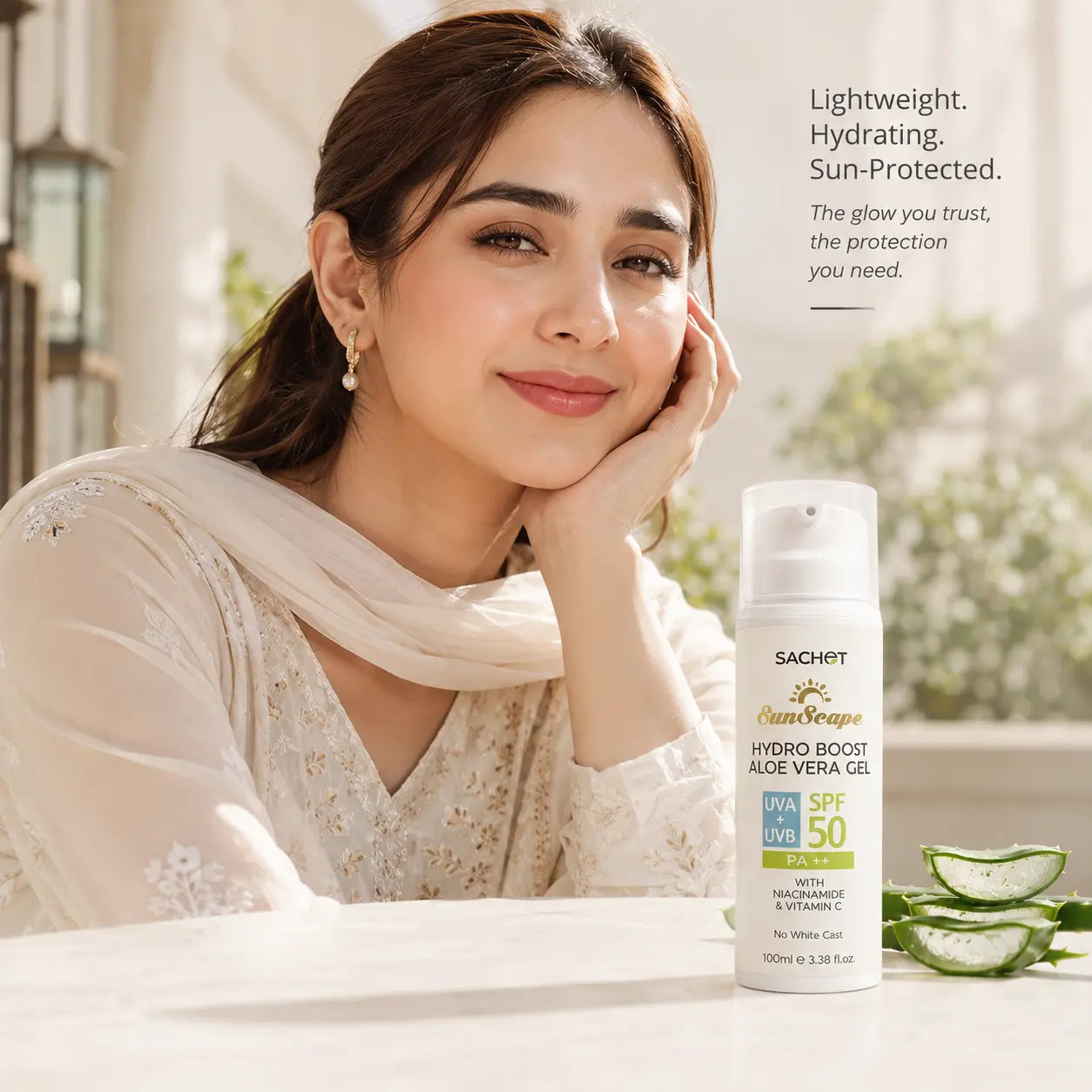
Which Sunscreen Is Better for Your Skin Type?
| Skin Type / Concern | Best Sunscreen Type | SACHET Pick |
|---|---|---|
| Sensitive skin | Mineral-first sunscreen. | Mineral Sunscreen SPF 70 |
| Oily or acne-prone skin | Gel sunscreen — no white cast. | Aloe Vera Gel SPF 50 |
| Dry skin | Moisturizing sunscreen — no white cast. | Glow Boost SPF 65 |
| Uneven tone or white cast concern | Tinted sunscreen — no white cast. | Tinted Sunscreen SPF 65 (BB Cream Coverage) |
Which Works Better in Pakistan's Climate?
Pakistan has different weather challenges depending on the city and season. The best sunscreen type should match both your skin and your environment.
| Location / Weather | Common Concern | Best Sunscreen Type |
|---|---|---|
| Karachi humidity | Sweat, shine and oily feel. | Gel sunscreen — no white cast. |
| Lahore summer heat | Strong sunlight and sweaty skin. | Gel SPF or tinted SPF — no white cast. |
| Islamabad dry weather | Tightness and dryness. | Moisturizing sunscreen — no white cast. |
| Sensitive skin in any city | Redness, stinging or irritation. | Mineral-first sunscreen — blend well. |
Is Mineral Sunscreen Safer Than Chemical Sunscreen?
Both mineral-first and chemical-style sunscreens can be suitable when used correctly. The better question is not which one is universally safer — it is which one your skin tolerates better.
- Choose mineral-first sunscreen if your skin gets red, irritated or reactive easily.
- Choose gel sunscreen if your skin is oily, sweaty or dislikes heavy creams.
- Choose tinted sunscreen if white cast is your biggest concern.
- Choose moisturizing sunscreen if your skin feels dry or tight after SPF.
Bottom line: Mineral-first sunscreen is best for sensitive skin. Gel sunscreen is best for oily skin. Tinted sunscreen helps avoid white cast. Moisturizing sunscreen is better for dry skin.
Key Ingredients in Mineral Sunscreen — What They Do
| Ingredient | Type | Role |
|---|---|---|
| Zinc Oxide | Mineral UV filter | Primary physical UV protection. Gentle on sensitive skin. |
| Titanium Dioxide | Mineral UV filter | Primary physical UV protection. Works alongside Zinc Oxide. |
| Ceramides | Skincare ingredient | Supports skin barrier and moisture retention. Not a UV filter. |
| Avobenzone | Stabilizer (low quantity) | Helps stabilize the formula and improve texture and wearability. |
| Benzophenone-3 | Stabilizer (low quantity) | Supports formula stability. Used in small quantities in many mineral-first formulas. |
Common Myths About Mineral Sunscreen
-
Myth: Mineral sunscreen is always thick and hard to blend.
Truth: Modern mineral-first hybrid formulas are more wearable and blend better when applied in thin layers. -
Myth: Any stabilizer in mineral sunscreen makes it a chemical sunscreen.
Truth: Mineral-first sunscreens can include small stabilizing ingredients while still leading with mineral UV filters for primary protection. -
Myth: Mineral sunscreen always leaves heavy white cast.
Truth: Thin layers and proper blending significantly reduce visible cast. -
Myth: SPF 70 means sunscreen lasts all day.
Truth: Reapplication is still needed every 2–3 hours outdoors.
How to Apply Mineral Sunscreen Without White Cast
- Apply moisturizer first if your skin is dry.
- Use small dots across face and neck.
- Blend in thin layers instead of one thick layer.
- Give it 1–2 minutes to settle.
- Reapply every 2–3 hours when outdoors.
Helpful Sunscreen Guides
Final Verdict
Choose mineral-first sunscreen if your skin is sensitive, reactive, redness-prone or recently treated. SACHET Mineral Sunscreen SPF 70 leads with Zinc Oxide and Titanium Dioxide for mineral UV protection, with small stabilizing ingredients for better blending and wearability. Apply in thin layers and blend well.
Choose gel sunscreen if your skin is oily, sweaty or uncomfortable with heavy SPF textures. For sensitive skin, SACHET Mineral Sunscreen SPF 70 is the strongest match. For oily skin and humidity, Aloe Vera Gel Sunscreen SPF 50 is the better lightweight choice with no white cast.
FAQs About Mineral vs Chemical Sunscreen
Is mineral sunscreen better than chemical sunscreen?
Mineral-first sunscreen is usually better for sensitive or reactive skin because it leads with mineral UV filters like Zinc Oxide and Titanium Dioxide. Lightweight gel sunscreen often feels better for oily skin and humid weather. The best choice depends on your skin type.
Which sunscreen is best for sensitive skin?
Mineral-first sunscreen is often preferred for sensitive skin because Zinc Oxide and Titanium Dioxide are usually more comfortable for reactive skin types. SACHET Mineral Sunscreen SPF 70 is formulated with these mineral UV filters as the primary protection.
Which sunscreen is best for oily skin?
Lightweight gel sunscreen is usually better for oily skin because it feels less greasy and absorbs more comfortably in humid weather. SACHET Aloe Vera Gel Sunscreen SPF 50 is a transparent gel with no white cast.
Does mineral sunscreen leave white cast?
Some mineral sunscreens may leave a slight white cast if applied too heavily. Applying thin layers and blending well significantly reduces visible cast. Modern mineral-first hybrid formulas are designed to be more blendable than older pure mineral formulas.
What is a hybrid mineral sunscreen?
A hybrid mineral sunscreen leads with mineral UV filters like Zinc Oxide and Titanium Dioxide for primary protection, but also includes small stabilizing ingredients to improve texture, blending and wearability. This is standard practice in modern sunscreen formulation and makes the product more comfortable for daily use.
Is Zinc Oxide good for sensitive skin?
Yes. Zinc Oxide is a mineral UV filter commonly used in sunscreens for sensitive or reactive skin. It is one of the primary UV filters in SACHET Mineral Sunscreen SPF 70 alongside Titanium Dioxide.
Choose Your Sunscreen by Skin Type
Pick mineral-first SPF for sensitive skin or gel SPF for oily skin and humid Pakistani weather.
Explore SACHET Sun Care


